

Your MCP server just became an agent you have to operate
Anthropic's MCP anniversary release gives servers skills, background tasks, approval prompts and direct file uploads. A tool call is now a job lifecycle your client has to own.
Anthropic marked the second anniversary of the Model Context Protocol on Tuesday by shipping three things at once: Skills over MCP, general availability for Tasks and Elicitation, and a draft extension for file uploads. The line that matters for anyone maintaining an integration came from Den Delimarsky, a lead maintainer of MCP: these features let Claude treat an MCP server "more like another agent that it can learn from and delegate work to."
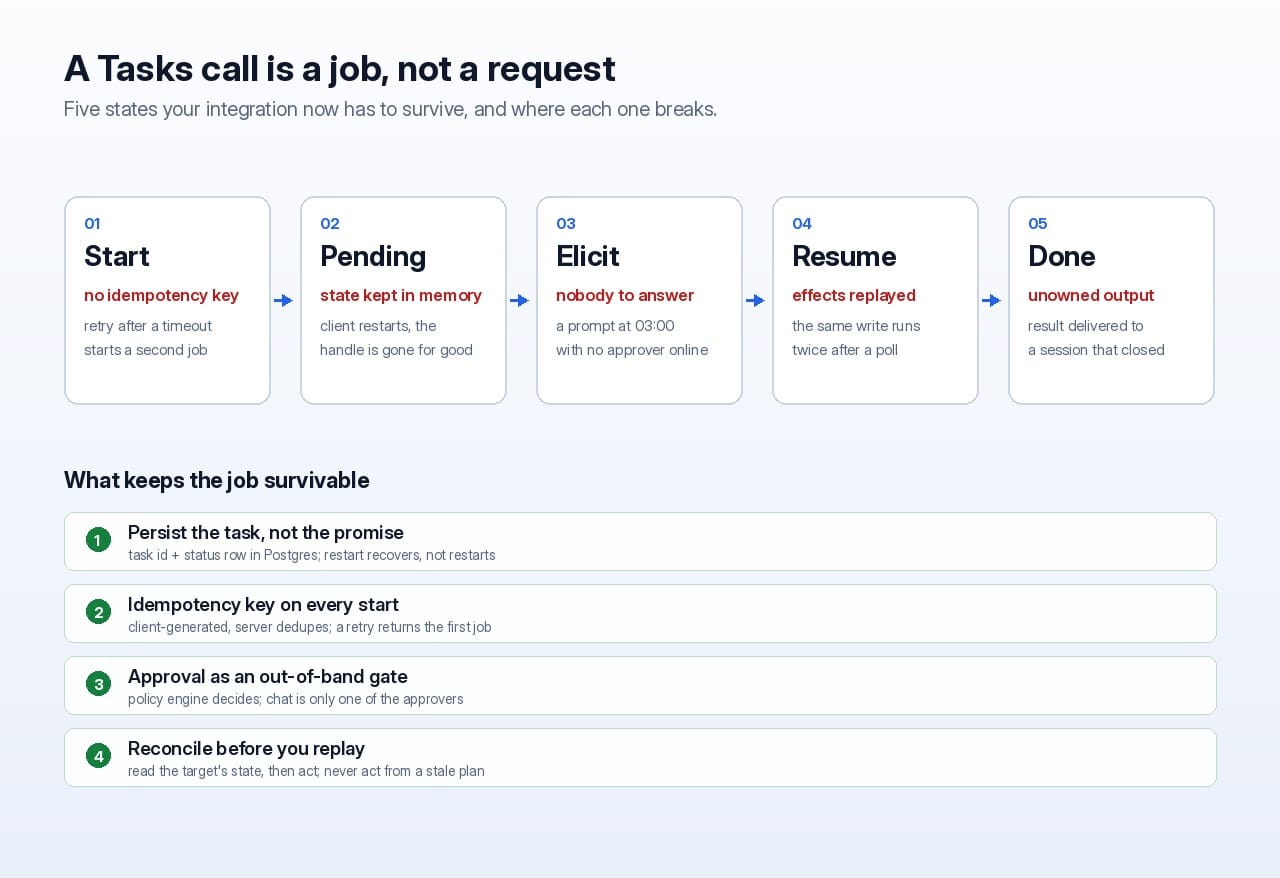
That is a spec change disguised as a product announcement. For two years MCP was request/response: your agent called a tool, the server did a small bounded thing, the answer came back in the same turn. Now the server can start a job, work for hours, ask a question in the middle, and report back when it is done. The protocol grew a lifecycle; most client code has not.
What actually shipped
Anthropic says the MCP SDKs now see more than 700 million downloads a month, up from 400 million in July, with over 10,000 connectors for Claude. The July spec revision removed sessions and made the protocol stateless — aimed at anyone who discovered that stateful MCP servers behind a load balancer are miserable to operate.
- Tasks: a server starts a background job and notifies the client when it finishes. Generally available in Claude and Claude Code on Pro, Max and Ultra; rolling out to Team and Enterprise. ZoomInfo already uses it for account research that used to take several prompts.
- Elicitation: the server pauses to ask before something expensive or irreversible. Supabase confirms cost before creating a paid project; GitHub makes you type a repository name before an agent can delete it.
- Skills over MCP, an official extension since September, is in public beta — servers publish instructions alongside their tools and update both together. Shopify, HubSpot and Atlassian are first; Microsoft Foundry has it in preview.
- File uploads, still a draft, keep bytes out of the model context: the server returns a pre-signed URL and the client uploads over HTTPS. Intuit and Dropbox are the first servers.
A tool call is now a job
Everything we have written about agent infrastructure — routing decisions that should not cost a model call, why idling, not isolation, dominates sandbox cost — assumed a bad call fails fast and costs a retry. A Tasks call can run for hours, and its failure modes are the classic ones from job queues, arriving in a protocol designed for synchronous tool use.
There is no idempotency story in the announcement, and a client that retries a start call after a timeout now has two jobs running against one account. The task handle lives somewhere, most likely in the client process, and a restart loses it. Elicitation assumes a human will answer, which is fine at 11am and wrong at 3am. And a finished task delivers its result to a session that may have closed hours earlier.
Soria Parra's framing is that this matches how people work: you kick something off and wait. True, and the consequence is that the client becomes a supervisor rather than a caller. Supervisors persist state, reconcile before acting, and own the result.
The second, quieter change
Skills over MCP should worry security teams, and the maintainers say so. "Skills are text that steers the model, and that comes with security and approval implications, and those are the difficult part," Soria Parra told The New Stack. "Reading a file over MCP and giving it to a context is the easy part."
Read that as an architecture statement: your prompt surface now has a vendor release channel. A server you approved in March can change the instructions your agent follows in June, with no deploy on your side. And because many servers require login, those instructions can be generated per organisation — a personalisation feature that is also a per-tenant injection path. That is a different threat model from the usual agent attack surface, because the payload arrives through a channel security review treats as configuration. So log the skill text your client loads with a content hash, gate it behind the same review as a dependency bump, and treat any instruction in a skill to run a command or skip a confirmation as untrusted input rather than policy. If your agents touch customer data under DPDP, a personalised skill is personal data leaving your boundary.
Extensions, not core
None of these features is in the core protocol, by design: adding to MCP is easy, removing is not, with thousands of servers in production. The graveyard is instructive — sampling, which let a server borrow the client's model, was deprecated in July. What you build on these extensions should work in any compatible client, but adoption beyond Claude is unproven.
Checklist before a production agent hits a Tasks-capable server
- Generate an idempotency key per logical job, and store the key-to-task-id mapping before you send the request.
- Persist task state — id, status, owner, deadline, result pointer — in your database, not in process memory.
- Reconcile before replay: on resume, read the target's state and act on the difference, not on a stale plan.
- Put a deadline on every task. A job with no timeout is an orphan with a budget.
- Route Elicitation to an approval queue with an SLA and an escalation path; never let it block a job overnight.
- Make destructive actions confirm-by-typing, the way GitHub does, not confirm-by-clicking.
- Log every server-supplied skill with a content hash, and alert on change.
- Validate uploads server-side after the pre-signed transfer — the protocol sets no size limit, so your server must.
- Keep an audit trail from task to write, so a bad result traces back to a job.
- Test the ugly paths: kill the client mid-task, expire the handle, reject the prompt.
None of this is exotic. It is job-queue discipline applied to a protocol that spent two years behaving like a function call. The teams that get value from Tasks next quarter will be the ones who wrote down what happens when the process dies at hour three.
Header photo: "AMS-IX optical patch panel" by Fabienne Serriere, licensed CC BY-SA 3.0, via Wikimedia Commons. Cropped for layout.