

Your AI agent is an attack surface
Hitachi and CrowdStrike just opened an AI-security centre in Bengaluru. What it signals for teams shipping agents — and the controls to add before launch.

In September, researchers documented a Windows malware strain that used four different AI models — DeepSeek, Qwen, Mistral and Gemini — to decide what to do next. It did not need a human operator to choose its path. That is the part worth sitting with: the attacker's bottleneck was never malware authoring. It was judgement. Judgement is now cheap.
Which is why an announcement out of Bengaluru this week deserves more attention than it will probably get.
What actually happened
Hitachi Systems India has opened an Advanced Global Delivery Centre in Bengaluru with CrowdStrike, aimed squarely at the security risks created by AI adoption. Three pieces matter:
- Project QuiltWorks — CrowdStrike's initiative that pairs frontier models from OpenAI and Anthropic with threat intelligence and agentic automation to find vulnerabilities those models help expose.
- FAIRR (Frontier AI Readiness and Resilience) — advisory and remediation, combining AI-driven scanning with human prioritisation.
- Falcon Guardian — AI Detection and Response for agents, including an AI kill switch to terminate a misbehaving agent.
Hitachi will deliver these as managed services to clients across India, Asia Pacific and the Middle East, alongside next-gen SIEM work that moves teams from legacy log collection toward an agentic SOC.
Read the press release and it sounds like a vendor partnership. Read it as an engineer and it is a warning: the security industry has decided that agents themselves are the new attack surface.
Three properties that make agents different
Traditional software does exactly what a developer wrote. An agent decides, per run, what to do with credentials it has been handed. That changes the threat model in three ways.
- Agents hold real credentials. A tool integration is a set of API keys; a compromised agent is a compromised account with your permissions.
- Agents ingest untrusted text. A support ticket, a PDF, a web page, a WhatsApp message — any of these can carry instructions that the model may follow. Prompt injection is not a theoretical bug class; it is a design constraint.
- Agents take irreversible actions. Sending mail, moving money, deleting records, calling a government API. A wrong answer is an incident, not a bug report.
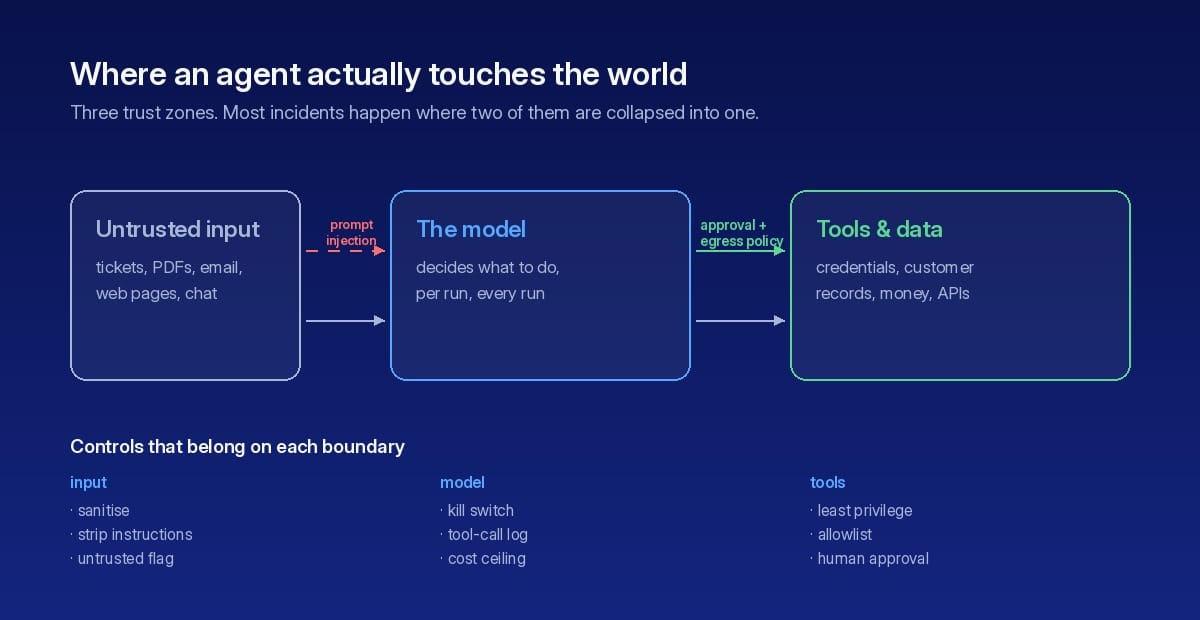
The trust boundary most teams skip
If you are shipping an agent, draw three zones and be ruthless about what crosses between them: the model, the tools, and the data. Most incidents we see in review come from collapsing all three into one trust domain, usually because it was faster to demo that way.
The uncomfortable corollary: an agent that can read a customer's email and call a refund API and has no approval step is not a feature gap. It is an unmanaged risk with a logo.
A checklist that survives contact with production
- Least privilege per tool, not per service. A tool that reads invoices should not be able to write them.
- Egress allowlists. An agent that can call any URL can exfiltrate anything it can read.
- Human approval for irreversible actions. Cheap to build, impossible to retrofit after an incident.
- Log every tool call with inputs, outputs, latency and the model's stated reason. If you cannot reconstruct a run, you cannot defend it.
- A kill switch. One flag that halts tool execution without a redeploy. This is the single most common gap in reviews.
- Prompt-injection tests in CI. Treat untrusted-content handling as a test suite, not a code review comment.
- Cost and rate ceilings. Retry loops are both a billing risk and a denial-of-service vector.
- Secrets isolation. The model should never see a raw credential; the tool layer holds it.
None of this is exotic. It is unglamorous platform work — which is exactly why it gets deferred until a client asks.
The India angle is not decorative
Two regulators now point at the same controls. India's DPDP Act makes consent, retention and deletion auditable obligations, and an agent that touches personal data inherits all three. When a client asks "can you prove what the agent did with this record and why", the answer has to come from logs you already keep, not an investigation you start afterwards.
That is also the commercial opening for Indian engineering teams: the buyers are no longer asking whether you can build an agent. They are asking whether you can operate one under audit. Those are different products, and the second one is where the margin is.
What we take from this
The Hitachi–CrowdStrike centre validates a direction we already build toward: agents are infrastructure, and infrastructure needs boundaries, telemetry and a way to stop it. If you are planning an agent rollout this quarter, start with the kill switch and the tool-call log. Everything else gets easier once those exist.
The demo era is over. The operating era has different requirements.