

Claude Code's Code Mode moves the review boundary up a level
Anthropic's experimental Code Mode lets Claude Code write JavaScript that orchestrates tool calls. The token savings are modest and unverified; the real change is that review moves from each action to each program.

Anthropic shipped a change to Claude Code this week that relocates where the important decisions happen in an agent loop. It is called Code Mode: instead of asking for one tool call, reading the result, and deciding again, the model writes JavaScript that makes several tool calls.
That reads like a developer-experience tweak. Read the permission section and it is closer to an architecture change, because the unit of review stops being the tool call.
What shipped
InfoQ reported the feature on 23 November. Code Mode is experimental, off by default, needs Claude Code v2.1.323 or later, and turns on with CLAUDE_CODE_EXPERIMENTAL_CODE_MODE=1. The documentation warns it "may change or be removed in any release."
The scope restrictions are informative: it works only in an interactive terminal session on the native build, on Opus 5.5, Sonnet 5.5, Haiku 5.5 or Fable 5.2, through a Claude subscription or Console account — not with -p, the Agent SDK, the VS Code panel, the Desktop app, Bedrock, gateways, or zero-data-retention organisations. Project settings cannot enable it, and managed settings can pin it to 0 but cannot force it on. That scope says it is for a human at a terminal, not a CI pipeline.
The mechanical change
The current loop is chatty by construction. The model requests a Bash call, waits, receives the whole result, then decides again. Every call costs a model turn, and every byte of every result — a 400-line test log, a directory listing, an edit diff — crosses the context window even when five percent of it matters.
Code Mode collapses that. The documentation's example raises a retry limit:
const files = await $`rg -l "function retryPolicy" src`.text();
const target = files.trim().split("\n")[0];
await edit(target, "maxAttempts: 3", "maxAttempts: 5");
({ edited: target, tests: $`npm test -- retryPolicy`.nothrow() });
The model gets a path and the test output, not the file contents or the full log; the conversation still shows each call and diff, with the code collapsed behind Ctrl+O. Anthropic recommends it for changes repeated across many files, searches whose results need filtering, and independent commands that can run at once.
What the numbers say
Anthropic published no token or latency figures. The only public measurement is from George (@bolyki), across eight interactive Sonnet 5.5 runs: same results every time, context 20-25% smaller, and on the larger task 37% fewer tokens at 19% lower cost — but not faster, and on a tiny task more expensive.
Eight samples are not a benchmark, but the mechanism explains the shape: fewer tokens get written, while the tool calls still execute, so the latency floor is your slowest command.
The review boundary moved
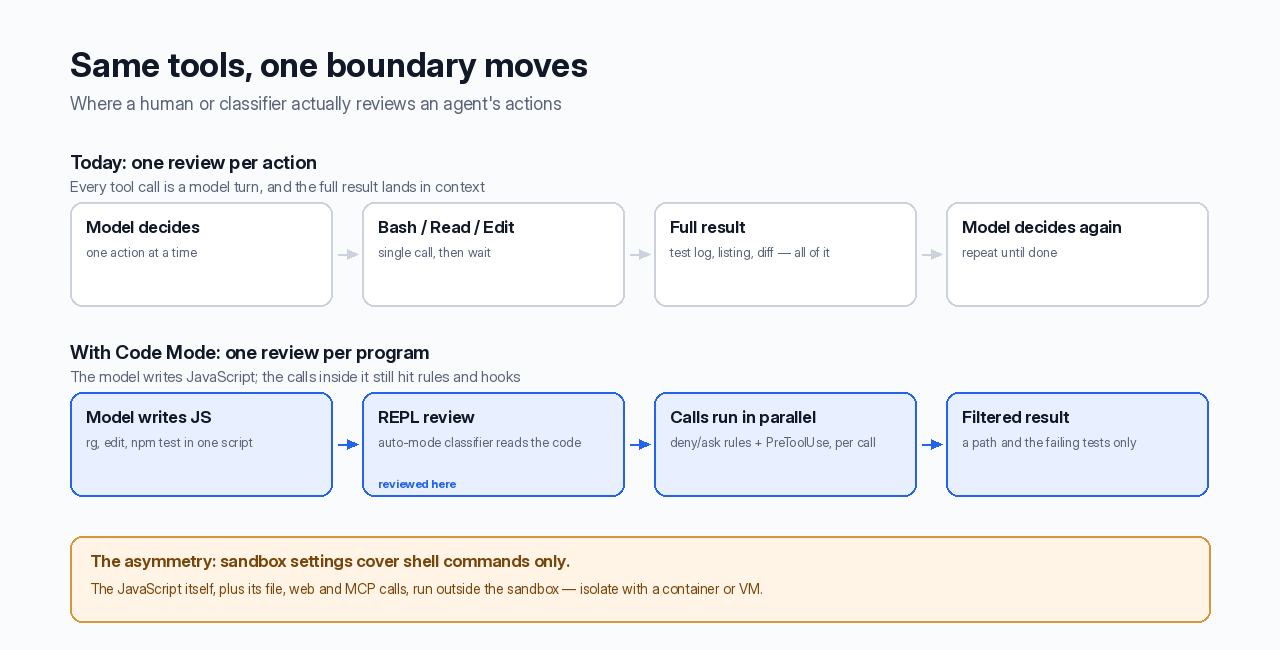
Each call inside the script still passes your deny and ask rules and PreToolUse hooks under the tool's usual name — Bash, or an MCP tool's. What changes is auto mode: the classifier reviews the code before it runs, not each call, and it cannot see values computed at run time, such as a path taken from search output. A rule written against a literal target still catches the literal form and may miss the computed one.
Hooks get harder. The docs warn that a git push inside a folder named app can reach your hook as cd 'app' && git push, so a hook must check every part of a command. To review the script itself, match REPL and read the JavaScript from tool_input.code, or set {"permissions":{"ask":["REPL"]}} so Claude Code asks before each piece of code starts.
Two changelog entries show the surface still moving. Since v2.1.328, UserPromptSubmit hooks no longer receive script output — redaction moved to a PostToolUse hook on REPL, which returns updatedToolOutput. Since v2.1.329, a PreToolUse hook that errors no longer refuses a script's tool call; you must set "onFailure": "block". If your redaction lived in UserPromptSubmit, it has been silently off for the calls that matter most.
Telemetry has a matching trap: events still carry each tool's normal name, so existing queries under-count instead of breaking. Calls from code carry tool_use_id values starting with repl_ or toolu_cc_. Leave OTEL_LOG_TOOL_DETAILS unset — code can read a token from a file and hand it to another call.
The asymmetry nobody mentions
Sandbox settings apply to the shell commands the code runs. The JavaScript itself, and its file, web and MCP tool calls, run outside the sandbox; to isolate those, the docs say to run Claude Code in a container or virtual machine.
Code Mode is a batching layer, not a containment boundary. If your threat model depended on a human eyeballing each call, one approved script can now contain thirty.
Operating notes
Code Claude waits on stops after ten minutes; sessions started in auto or bypassPermissions mode can push it to the background for up to two hours, which is the only way to survive a full test suite. Resuming requires the environment variable to stay set.
For delivery work the useful pattern is a function call tree instead of a conversation: change forty files, run the suite, read only the failures — a codemod with a review gate, and a better fit for our engineering engagements than exploratory debugging.
Checklist before you turn it on
- Pin the version and record the environment variable per repo; the feature can be removed in any release.
- Move secret redaction from
UserPromptSubmittoPostToolUseonREPL, handling a nullresult. - Audit
PreToolUsehooks for multi-segment commands (cd X && cmd) and computed paths. - Add
{"permissions":{"ask":["REPL"]}}wherever you want to read the script first, and"onFailure": "block"on any hook that must refuse. - Leave
OTEL_LOG_TOOL_DETAILSunset; filter traces byrepl_so dashboards count code-made calls. - Keep container isolation for the JavaScript and its file, web and MCP calls, not only Bash.
- Budget for the ten-minute cap: short test targets, or start in auto mode for background runs.
- Re-measure on your own load before quoting the savings internally.
The feature is not the interesting part. As agents move from one call at a time to code that orchestrates calls, every control built around "review each action" needs a plan for "review each program" — and most hook configurations in the wild still assume the first model. That gate is the piece to budget first; the rest is engineering we can help with.